

The freelance economy has matured significantly since the pandemic reshaped how we work. What started as a necessity has evolved into a preferred lifestyle for millions. Remote work is now the norm rather than the exception, and freelance writers have moved beyond the “lone wolf” stereotype to embrace collaborative approaches that amplify their success.
Modern freelancers understand that collaboration isn’t just beneficial—it’s essential. The concept of “teamlancing” has gained serious traction, with writers forming strategic partnerships that expand their capabilities and opportunities. Gen Z continues to lead the freelance charge, while millennials have cemented freelancing as a viable long-term career path.
Working together brings both practical and psychological benefits. Humans thrive in collaborative environments, and freelancers are no exception. Here’s how you can leverage collaboration to build a stronger, more sustainable writing career, with specific examples of how these partnerships actually work.
1. Work with Content Marketing Agencies Instead of Direct Clients
Rather than constantly hunting for individual gigs on platforms like Upwork or Fiverr, consider partnering with established content marketing agencies. These agencies work with multiple clients simultaneously and need reliable writers they can count on.
Here’s how this collaboration works in practice:
When an agency lands a new SaaS client who needs 12 blog posts monthly, they don’t expect one writer to handle everything. Instead, they might assign you four posts in your specialty area (let’s say cybersecurity), while two other writers cover complementary topics like cloud infrastructure and data analytics. You’ll often work in a shared Google Drive where you can see each other’s outlines and finished pieces, ensuring consistency in tone and avoiding content overlap.
Many agencies use a pod system where 3-5 writers collaborate on the same client account. You might join a weekly Slack huddle where the team discusses upcoming content, shares research findings, and flags any challenges. For example, if you discover that the client’s competitor just published a comprehensive guide on a topic you were planning to write about, the team can pivot together and approach the subject from a fresh angle.
Some specific agency collaboration models include:
- Tag-team editing: You draft the content, another writer reviews and enhances it before it goes to the client
- Specialist rotation: Different writers handle different content types for the same client (you write the blog posts, someone else does the case studies, another handles the email campaigns)
- Research sharing: Multiple writers contribute to a shared research database or content brief template, making everyone’s work more efficient
Tools like Asana, Notion, and Google Workspace have become industry standards for remote team coordination, letting you track who’s working on what and when each piece is due.
2. Expand Your Service Offerings Through Strategic Partnerships
No writer excels at everything. Strategic collaboration means you can take on projects that would normally be outside your wheelhouse by partnering with writers who complement your strengths. Emphasis on strategic.
Specific collaboration structures include…
The skill-swap partnership: You might partner with another writer where you handle the creative storytelling, and they ensure the technical accuracy. For instance, if you land a project writing white papers for a fintech company, you could craft the narrative flow and key messaging while your partner (who has a finance background) ensures all the regulatory information and financial concepts are accurate. You split the fee 50/50 or based on the time each of you invests.
The format specialist team: Create a small team where each person owns a specific content format. You might be the long-form blog expert, while your partners specialize in social media copy, email sequences, and video scripts. When a client needs a full content marketing package, you pitch as a team and each person delivers their specialty. For example, you write the cornerstone blog post, your social media partner creates 15 promotional posts for LinkedIn and Twitter, and your email specialist crafts a 5-email nurture sequence—all based on the same core message.
Co-authoring arrangements: Team up to write e-books, comprehensive guides, or series content. One writer I know partnered with a subject matter expert to create an online course for entrepreneurs. She handled all the writing and storytelling, while her partner provided the business frameworks and teaching methodology. They co-branded it and split the revenue.
The accountability pod: Form a small group (3-4 writers) who meet weekly via Zoom to review each other’s work, brainstorm ideas, and hold each other accountable to deadlines. You’re not necessarily working on the same projects, but you’re providing feedback, catching errors, and pushing each other to improve. This is especially valuable for complex projects where a fresh set of eyes prevents costly mistakes.
A travel writer I know partners with a photographer. He writes destination guides while she provides original photography. They pitch travel publications together and split the fee. Their combined offering is more attractive to editors than text-only submissions, and they both get more work as a result.
3. Outsource and Delegate to Scale Your Business
As your reputation grows, so will your opportunities. The key to sustainable growth isn’t working more hours—it’s building a network of trusted writers you can delegate to when your workload exceeds your capacity.
How might this look? Here are a few models to follow.
The overflow system: Build relationships with 2-3 writers who work at your level. When you’re at capacity, you pass projects to them with clear briefs, style guides, and client context. You might mark up their rate by 15-25% to cover your project management time, or simply charge a finder’s fee. For example, if a client needs 8 blog posts but you can only handle 4, you keep 4 and refer 4 to your trusted collaborator, maintaining the client relationship for both of you.
White-label services: Take on larger projects and hire other writers to execute them while you manage the client relationship. Let’s say a client needs a complete content overhaul: 20 blog posts, 10 landing pages, and 6 case studies. You might write the cornerstone pieces yourself, but hire specialists for the rest. You provide detailed brand guidelines and review all content before it goes to the client. The client sees you as their single point of contact, while you’re actually coordinating a small team behind the scenes.
The apprentice model: Bring on less experienced writers and mentor them while they handle research, first drafts, or simpler projects. You edit and refine their work, teaching them your process. This works especially well for high-volume, lower-complexity content like product descriptions or listicles. You might pay them $0.10/word while you charge the client $0.25/word, and everyone benefits—they get experience and steady work, you scale your capacity, and the client gets quality content delivered on time.
Project-based teams: For large projects like creating an entire content library or writing a book, assemble a temporary team. You might hire a researcher to gather all the data and statistics, a first-draft writer to get words on the page, and then you handle the heavy editing and final polish. This assembly-line approach lets you take on projects that would take you months to complete solo and finish them in weeks.
Specialized partnerships: Partner with writers who handle tasks you dislike or aren’t skilled at. Hate writing meta descriptions and SEO titles? Find someone who loves that detail work and pay them to optimize everything you write. One writer I know focuses only on writing first drafts for long-form content, then partners with an editor who transforms those drafts into polished pieces. They’ve essentially created a two-person content production line.
You’ll need proper systems: project management tools like Trello or Monday.com, shared style guides in Notion, and clear contracts that outline how you’ll work together and split payments.
4. Build Your Network Through Online Communities and In-Person Events
The freelance writing community has exploded online, with active groups on LinkedIn, Facebook, Discord, and specialized platforms like Reddit’s r/freelancewriters. These communities serve multiple purposes: finding work, learning skills, and connecting with potential collaborators. How do you take advantage of these?
Community matchmaking: Many Facebook groups and Discord servers have dedicated channels where writers can post when they need help with overflow work or specific expertise. For example, in the “Freelance Content Marketing Writers” Facebook group, someone might post: “I have a client who needs technical documentation for a medical device. Anyone with healthcare writing experience want to partner on this?” You respond, have a quick video call, and if you’re a good fit, you’ve found a collaboration partner.
Virtual co-working sessions: Join or create regular co-working sessions via Zoom or Discord where freelancers work in parallel. These aren’t formal collaborations, but they create accountability and often lead to partnerships. During breaks, you chat about what you’re working on, and naturally discover when someone’s skills complement yours. I know writers who met in a Tuesday morning co-working session and now regularly refer clients to each other.
Skill exchange programs: Some writing communities organize formal skill exchanges. You might teach a workshop on SEO writing in exchange for someone else teaching you about email copywriting. These exchanges build relationships that often evolve into paid collaborations. For instance, after teaching someone your process, they might reach out when they land a project that needs your specific approach.
Collaborative content creation: Partner with other writers to create resources for the community—maybe a comprehensive guide to freelance rates, a database of quality clients, or a series of case studies. This positions you both as experts and creates natural opportunities to promote each other’s services. Two writers might co-host a monthly “portfolio review” livestream where they give feedback to community members, building their reputations together.
Local freelancer meetups: Many cities have monthly or quarterly meetups for freelancers at coffee shops or co-working spaces. These in-person gatherings are perfect for finding collaborators in your area. You might meet someone who serves a different industry than you do, opening up referral opportunities. Or you discover someone who loves client communication (your weak spot) while you excel at research and writing (their weak spot)—instant partnership potential.
Strategic introductions: Make it a habit to introduce writers in your network to each other when you see collaboration potential. If you know a B2B SaaS writer who’s great at technical content and you meet someone looking for exactly that skill, connect them. They’ll remember your generosity and reciprocate when you need help.
The most successful collaborations start small. Don’t propose a major project with someone you just met online. Instead, test the waters with a small collaboration—maybe co-editing each other’s next blog post, or partnering on a single client project. If it goes well, build from there.
To summarize…
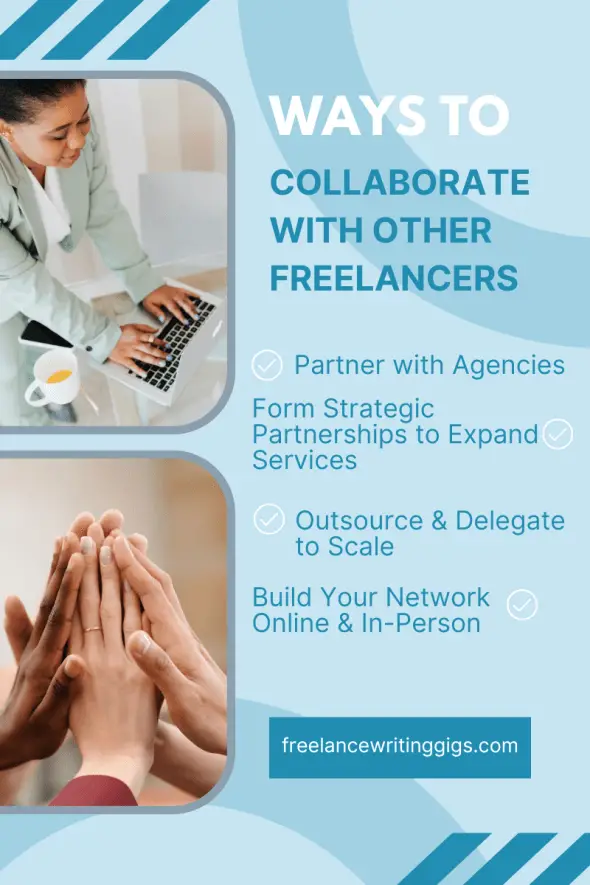
Start Your First Collaboration This Week
The freelance landscape will continue evolving, but collaboration consistently outperforms isolation. The writers building sustainable, six-figure careers aren’t working alone. They’re strategically partnering with others who complement their skills and amplify their reach.
You don’t need a formal business plan or a complete network to start. Pick one action from this article and execute it in the next seven days. Join one Facebook group for freelance writers and introduce yourself. Message one writer whose work you admire and ask if they’d be interested in reviewing each other’s next piece. Reach out to a content marketing agency in your niche and pitch yourself as a reliable team member. The smallest step toward collaboration today can transform into your most valuable professional relationship by this time next year.
Originally written by Elea Andrea Almazora- RingCentral US in 2021; updated by FWJ in 2026
Elea is the SEO Content Optimization manager for RingCentral, the leader in global enterprise communication and collaboration solutions on the cloud. She has more than a decade’s worth of experience in on-page optimization, editorial production, and digital publishing. She spends her free time learning new things.







Leave a Reply